Alison Averis
In 2001 I had a contract for a vegetation survey of the John Muir Trust land in Knoydart, including the hill of Ladhar Bheinn together with the slopes of Lì and Coire Dhorrcail where there is a programme of restoring native woodland. It was arranged that I would stay at Arnisdale, on the north shore of Loch Hourn, and be taken across the loch each day by Len Murray, who at the time operated a small ferry for the JMT.
This ferry actually consisted of a 12-foot open wooden dinghy with a single outboard motor, and some of the trips over the loch were extremely exciting and involved bailing with a bucket as we went. However, the first day was misty and still, with the sea slicked down like oiled satin. As we approached the farther shore Len indicated the remains of houses at the former crofting township of Lì – Knoydart had a population of almost 1000 by the middle of the 19th century – on a loch-side terrace at the foot of a slope clothed in huge multi-stemmed hazels. He pointed out the small stone slipways and launching points built by the previous inhabitants, now visible only from the sea, and as the fragrant breath of the new birch leaves streamed out over the water, Len cut the engine and we drifted in silently over the glassy water on to a sparkling beach of pure garnet crystals. I looked up at the green cascade of new woodland: a hanging garden of trees mounting the crags and ledges; and had a sudden desire to find a way to look at woods from the water. A way to get some insight into the lives and culture of our seafaring ancestors for whom the roads were the lochs and seas, and boats the main means of moving through a landscape.
I went home with a dream, and it remained a dream for seventeen years. Through all those years the dream was kept alive by that memory of the scent of the birch trees drifting out over the sea; that elusive, evocative scent that I swear would bring me back to life from a near-death experience. Nor am I the first to have that thought. In Dorothy Wordsworth’s Recollections of a Tour Made in Scotland (in 1803) she mentions the boatman who ferried her and her brother William along Loch Katrine to the Trossachs telling them, “ … it was pleasant and very halesome on a fine summer’s morning to sail under the banks where the birks are growing.”
Pushing the boat out
Five years ago we moved to a house within walking distance of a small reservoir-loch and a short drive from two more. Now there was a chance that the dream could come true. After weeks of research, I decided to get a good-quality inflatable kayak. Shorter and wider than a typical touring or ocean-going kayak, inflatable boats have the disadvantage of being comparatively slow (though they can go as fast as a rigid boat of the same size) and are not suitable for extreme white water, big surf or exposed sea crossings. These minor shortcomings paled into insignificance when set against the two great advantages of inflatables: they are very stable and almost impossible to capsize; especially important as I go alone; and, best of all, they are easily portable. Mine packs away into a rucksack leaving space for all the rest of the kit: buoyancy aid, spray-deck, pump, paddle and shoes – and then I can carry it to places where you couldn’t easily get a rigid kayak. I bought it in November 2017. There then arrived the most severe winter in this part of the country for 35 years. I didn’t actually push the boat out until May 2018.
When I did, on a quiet spring evening, it was everything I’d dreamed of. On that first trip to the nearest loch I paddled out to look at some of the fragments of woodland that still cling to the steep banks, and on a stretch of the shore that isn’t visible from any of the surrounding paths and tracks there was a great sheet of bluebells (wild hyacinth) in young bracken, their scent sweet and intense in the soft evening air. In south-east Scotland bluebells are strongly associated with ancient woodland: here was an unsuspected, unexpected fragment of the distant past, right on my doorstep. A day or two later, paddling at another site, I came upon an equally unexpected stand of aspen, the new leaves shimmering golden-green in the sunlight and reflecting the dazzle of the water below.
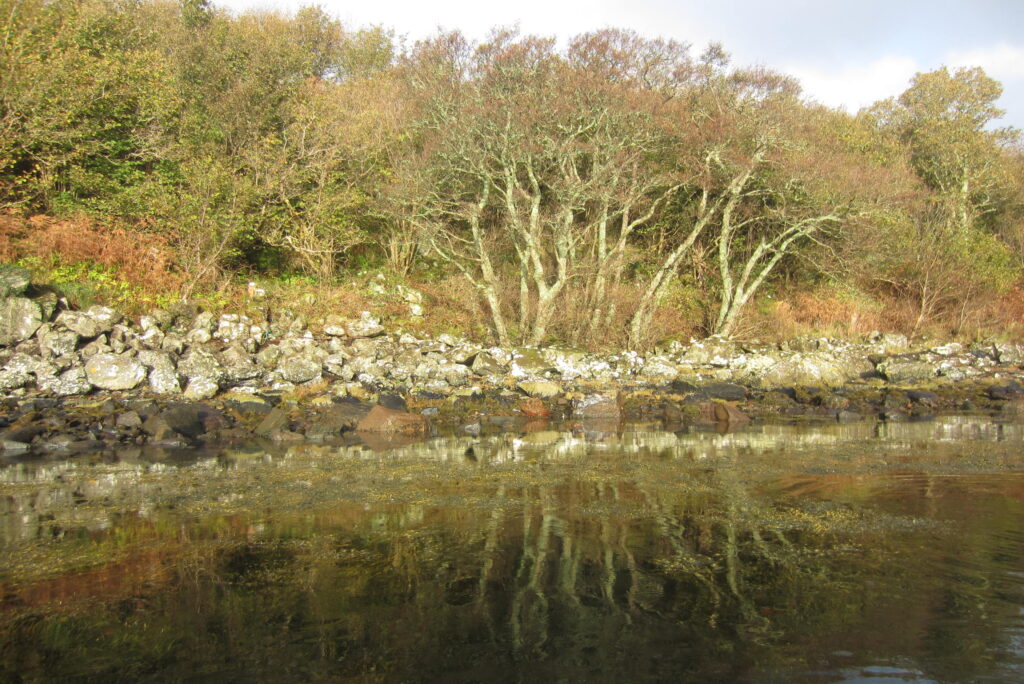
Rather than speeding heroically across open stretches of water, I’ve been sliding the boat into sheltered inlets overhung with flowering trees; the song of willow warblers falling like raindrops into the silence; cuckoos and curlews and lapwings on the hills beyond. Deer browsing at the shore barely lift their heads: on the water I’m not seen as a threat but just part of the scenery. It’s an intoxicating experience to be at the boundary between air, land and water; spaciousness and intimacy at the same time. And even the smallest patch of woodland looks wild and beautiful from the water.
Oak on the water
The part of Scotland that is now East Lothian was almost entirely cleared of trees by the late Iron Age, which is why the former coal-mining industry in the region dates back to Roman times, and why only about 2% of the county is now native woodland. It is also why we had only twelve potential attendees when I tried to organise an NWDG Excursion here in 2008. However, among this 2% are some fragments of ancient woodland, one of which is Pressmennan Wood, which covers the slopes of a narrow glen running east-west. Legend has it that Pressmennan oaks were used in the building of the Great Michael, which at the time of its launch in 1511 was the largest ship ever constructed. Though there is no direct evidence for this, Timothy Pont mapped Pressmennan in the late 16th century as an enclosed woodland, suggesting it was being protected from grazing and therefore valued as a source of timber. It’s still here and the canopy is still largely of oak, although there are also non-native species on the southern side of the glen, including beech, rhododendron introduced in Victorian times, and conifers planted by the Forestry Commission in the 1950s. In 1988 these southern slopes were acquired by the Woodland Trust Scotland and the native woodland is being restored. There’s a good series of paths running through the woodland, but the wilder, steeper ground is largely hidden from them.
In the bottom of the glen lies an artificial loch, constructed by damming the downstream end in 1819. It’s known as Pressmennan Lake: one of a small number of Scottish water bodies known as lakes. A kayak trip here would give me a great view of the hidden parts of the woodland, including a wooded island. This was where the portable, inflatable boat came into its own, as the launching site nearest to the car park proved to be a 15-minute walk along a muddy path under overhanging trees and necessitating a scramble over fallen trunks.
The boat was soon out of its bag and inflated, and I paddled into a different, primeval-feeling world. The steep slopes clothed with oak, birch, rowan and hazel rose directly from the water’s edge, entangled with fallen trees, dense thickets of young trees, brambles and bracken. Honeysuckle climbed into the canopy and spread a cascade of fragrant golden flowers. Under the trees were tall swards of heather and blaeberry, thinning out to open glades of ferns and flowers. There were wet woodlands too, with the birches and willows extending out into the shallow water and then giving way to swamps of sedges and water horsetails, jewelled with iridescent newly-emerged common blue damselflies.
Apart from a pair of dodgy-looking fishermen trying to conceal themselves on the far bank it was a silent and secret place, with the branches of oaks, ashes and hazels sweeping down in a green fringe against the dark water. But having evaded the fishermen I found myself heading for trouble of a different kind. As I approached the island with its dense stand of birches, I noticed a disturbance in the undergrowth and two swan necks came into view. Mr Swan got into the water in a business-like manner and paddled determinedly towards me, while Mrs Swan and seven cygnets lurked in the background. I made a hasty retreat: the combination of an inflatable boat and an angry bird was more alarming than that of an inflatable boat and fish-hooks.
The trip was hard work on a windy afternoon, but the impenetrable tangle of undergrowth in the surrounding woods would have been far harder to get through, and it was easy to see why our ancestors used boats whenever they could.
The lonely sea and the sky
For years I dreamed of my first sea-kayaking trip. It would be a windless, golden day in late May. The water would be like translucent blue-green glass; fathoms deep over white shell-sand and whispering in to a quiet shore. There would be birch trees glittering in spring sunlight and full of singing birds; the air would be scented with bog myrtle and bracken and bluebells; a cuckoo would be calling; there would be a blue horizon of high hills still patched with snow.
Needless to say, it wasn’t like this at all.
The scene was the Tay estuary; the sea grey as porridge and full of confused, lumpy waves. Water from the largest river in the country was pouring east at 175 cubic metres a second and meeting the incoming tide flooding west, while a brisk wind blew across the estuary at right-angles to both current and tide. A hundred metres offshore was a stretch of particularly boisterous water, and I had visions of the boat rotating in this, upside down, possibly with me still in it. To the north the sunlight shattered into a thousand pieces off the windows of Dundee.
There were still trees, though: a fringe of deciduous woodland along the southern shore. As I battled along in the wind, trying to steer a straight course through the steep and confusing waves, I reflected that this was probably far closer to the everyday experience of our ancestors: struggling along inhospitable coastlines in a small boat with a wet bum and a face full of sea-spray.
And it was still breathtakingly beautiful, with the sea shining like mercury under a vast blue and silver summer sunset sky.
Yon bonny banks
Looking at woods from the water is all I had hoped for, whether it’s green and gold groves on sheltered, gentle shores or vertical woods on rock ledges; wind-battered, crouching against the cliffs, gnarled by the wind. But though I have paddled on lochs from Lomond to Assynt, the most special place is still the closest one of all, just ten minutes’ walk from the house. One of the almost-lost woodlands of East Lothian, on slopes dropping all but sheer to the water. I float into hidden inlets, drifting over the drowned glen of the Thorter Burn. Before the dam was constructed in the early 20th century this piece of ground was a confluence of deep-cut ravines. There are tree symbols on the 19th century maps, and woodland shown in the area as far back as 1630, but despite all the changes through the centuries woodland survives here still: birch, hazel, rowan, willows; a single oak with its branches reaching out over the water; a few elms, ash, hawthorns, blackthorns; a tangle of honeysuckle and wild roses. In spring it is a vision of bluebells, primroses, stitchwort, celandine, with bracken fronds unrolling in the warming air. Here is my place of peace, in the breathless quiet of early morning; at the bright noontide; in the still of evening …
Poetic. Thanks for this.
Please do include photographs if you can.
Ava Greenwell/